History
Trifork Group was founded in Denmark in 1996. Between 2007 and 2014, the Group was listed on Nasdaq Copenhagen. At the beginning of 2014, the headquarters were moved to Switzerland, and Trifork Group AG was established as the holding company of the Group. As part of this reorganization, Trifork was delisted from Nasdaq Copenhagen. The company increased its international focus in these years and partnered with the software-focused private equity fund GRO Capital in 2015. GRO Capital exited its investment through an IPO on Nasdaq Copenhagen in May 2021. Today, the founder and CEO, Jørn Larsen, remains the largest shareholder with approximately 19% of the shares.
In a nutshell
Trifork is a pioneering global technology company, empowering enterprise and public sector customers with innovative digital products and solutions. With 1,197 employees across 16 countries, Trifork specializes in designing, building, and operating advanced software in public administration, healthcare, financial services, energy, and aviation.
The software industry is characterized by rapid change. Hence, Trifork always needs to be at the forefront of innovation to stay relevant for our customers. Our culture is deeply rooted in curiosity about new technologies. It means that we can attract highly skilled people, which in turn ensures competitive strength.
How we’re organized
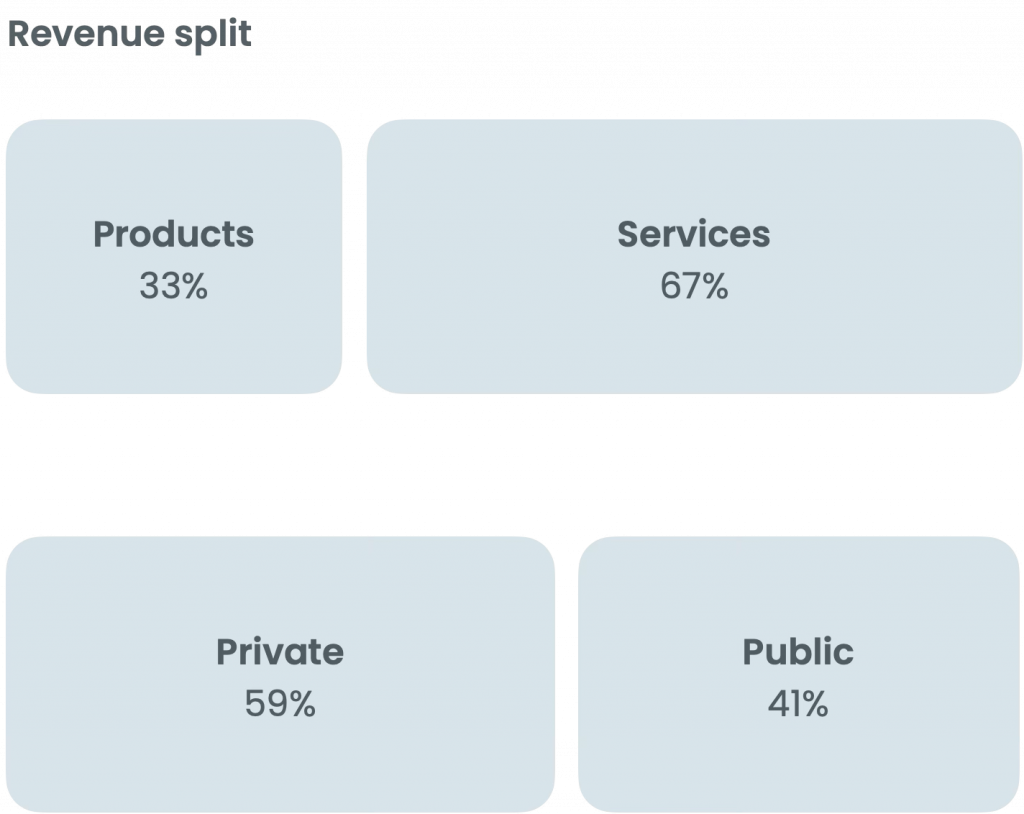
Trifork’s business offering centres around software products on one side, and services on the other. The work is done for private enterprises and public organizations.
Trifork’s go-to-market model is focused on productizing solutions with our service offering attached to the product engagements. Our core product areas are in health, financial services, energy, aviation, and public sector. These products are based on state-of-the-art AI functionality supported by hosting, security, and cloud operations.
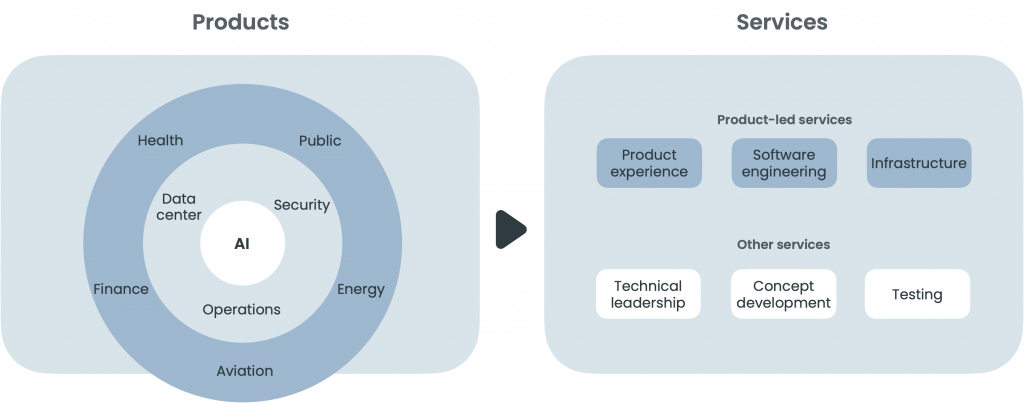
Our services are primarily delivered on a time and material basis or at a fixed price in cases where Trifork is responsible for the whole implementation of a solution. Most often, Trifork engages in long-term strategic partnerships with major customers. Service activities are being increasingly focused on the implementation, integration, and customization of Trifork products.
Acquisitions
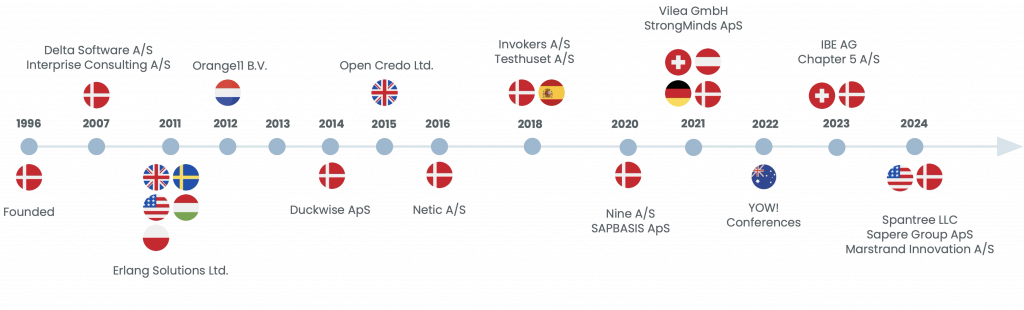
Trifork has made many acquisitions over the years, and acquisitions form an integral part of our growth strategy. We prefer to keep founders leading their company following the acquisition. We buy a majority stake initially, but founders retain significant ownership, and then we acquire non-controlling interests (NCIs) over time to ensure that founders are incentivized to perform well both operationally and financially over multiple years. Hence, the acquisition of NCIs is also an integral part of our M&A strategy. Acquiring NCIs increases the earnings per share of the Group.
The Trifork Labs segment
Trifork Labs leads Trifork Group’s strategic investment activities. We have been active in founding, co-founding, and investing in innovative software companies for more than 20 years, and currently hold minority stakes in 23 active companies.
These companies gain access to our network, management sparring, technology sparring, and the possibility to collaborate commercially with the business units in the Trifork segment.
Trifork Labs has participated in founding or making early investments in several successful companies including Humio, TradeShift, and Chainalysis. Our investment performance is in the top 5% of European venture capital investors over the past nine years. Labs has contributed around EURm 10 annually to the Group EBT since 2016, hence being a significant driver of shareholder value.
Our strength lies in our experience, partnership with growth investors, and business network. Our model of co-founding with entrepreneurs and partners is unique and a solid test of idea quality and commitment.
The book value of the investment portfolio currently stands at EURm 84. In the annual and semi-annual financial reports, you can read more details about the valuation methodologies (primarily based on last financing round by an external investor), value development, portfolio composition, and operational performance.